















System für fortgeschrittene Planung und Terminierung (APS-Software)
Ihre Produktion – perfekt geplant. Das Accevo APS-System ist ein spezialisiertes Softwaretool, das in Verbindung mit Ihrem ERP-System die Planung von Produktion, Logistik und Lieferketten in Echtzeit ermöglicht.
Was ist ein APS-System (Advanced Planning and Scheduling)?
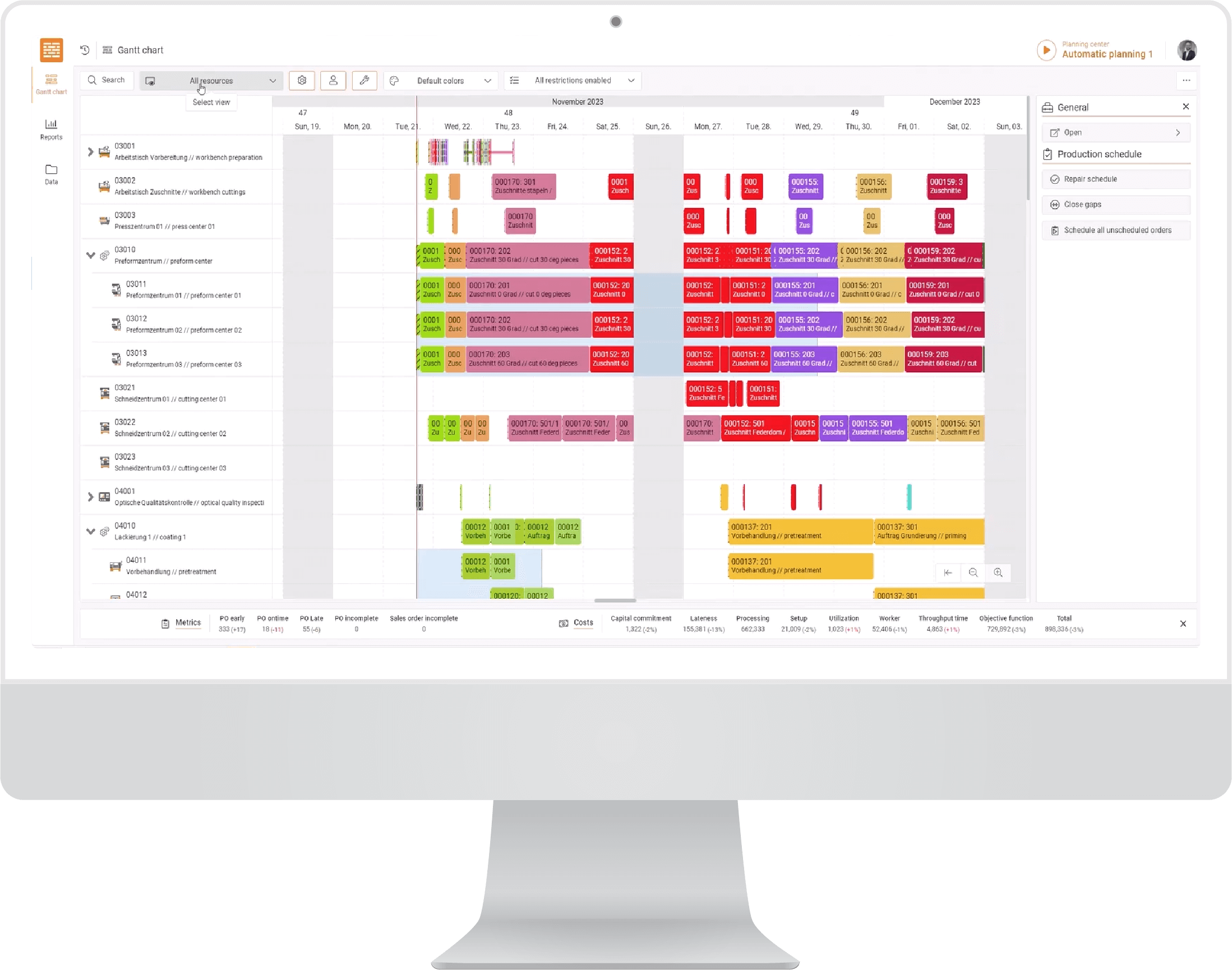
An APS system is software designed to tackle operational planning challenges in production, logistics and supply chain management. It works alongside ERP systems to plan across long, medium and short-term horizons, simulating multiple scenarios in real time to optimize throughput, reduce lead times, manage inventory and improve delivery performance. APS software can help in each industry replacing simple excel files and improving general manufacturing performance.
APS acts as the dynamic link between your high-level planning (ERP/SCM) and the realities on the shop floor. By ingesting real-time production data from ERP systems and sending back optimised production plans, APS transforms static schedules into agile, responsive workflows. In practice, this means you can reduce lead times, improve resource utilisation and keep your strategic goals aligned with what’s actually happening in production.
Abgedeckte Branchen
Fertigung (diskrete Fertigung, Prozessfertigung, Chargenfertigung)
Optimises production by reducing bottlenecks and managing capacity and materials.
Automotive
Enables just-in-time scheduling and adapts to complex, changing supply chains.
Speisen & Getränke
Schedules for freshness, allergen control, and ingredient availability.
Luft- und Raumfahrt
Manages long lead times, complex assemblies, and traceability.
Pharmazeutische
Supports compliance, batch tracking, and expiry-based planning.
FMCG
Handles fast-changing demand, short shelf life, and minimises waste.
Textilien
Deals with frequent order changes, colour variants, and machine planning.
Elektronik
Supports fast product changes and limited capacity with agile scheduling.
Wann sollte man überhaupt über APS-Software nachdenken?
Consider implementing an APS when your production plans become too complex for spreadsheets or manual methods to handle reliably. If you find yourself juggling multiple machines, materials and staff shifts—and struggling with late orders, bottlenecks or excess stock—an APS brings clarity and control. By running real-time simulations and optimizing every resource against your priorities, you can react quickly to changes in demand, avoid costly downtime and keep deliveries on track.
Intelligent Scheduling
Automatically sequence tasks to make the best use of machines and people, cutting idle time and speeding up delivery.
Solves: chaos from manual job sequencing and unexpected bottlenecks.
Material & Resource Planning
Ensure you have the right parts, tools and staff in place by matching material availability and capacity to your production needs.
Solves: costly stock-outs, over-ordering and unbalanced workloads
Live What-If Scenarios
Run instant simulations of changes—like rush orders or machine breakdowns—to see the impact and adjust your plan before issues arise.
Solves: the inability to foresee disruptions and adapt in time.
Warum sollten Sie sich für das APS-System von Accevo entscheiden?
Choose Accevo APS because it brings together powerful optimisation, deep MRP and real-time AI in one easy-to-use, web-based planner. You’ll benefit from multi-criteria scheduling that balances priorities like setup times, labour costs and delivery dates, plus built-in forecasting and promise-checks to keep stock lean and customers happy. Our skill-based workforce module and full tool-set management ensure the right people and equipment are always in place. With interactive dashboards, what-if simulations and seamless ERP/CMMS/WMS integration via REST APIs, Accevo APS gives you the control to react instantly to change and drive continuous improvement.
Powerful optimisation engine for faster, smarter scheduling
Deep MRP with built-in forecasting and ATP/CTP checks
Real-time AI learning for ever-more accurate plans
Multi-criteria scheduling (setup times, labour costs, delivery dates)
Skill-based workforce and full tool-set management
Interactive dashboards and instant what-if simulations
Seamless ERP/CMMS/WMS integration via REST APIs
Web-based planner for access anywhere, no client install needed
According to our clients, the implementation of the Accevo APS system enjoy:
Flexible cost-based optimisation with multiple target criteria
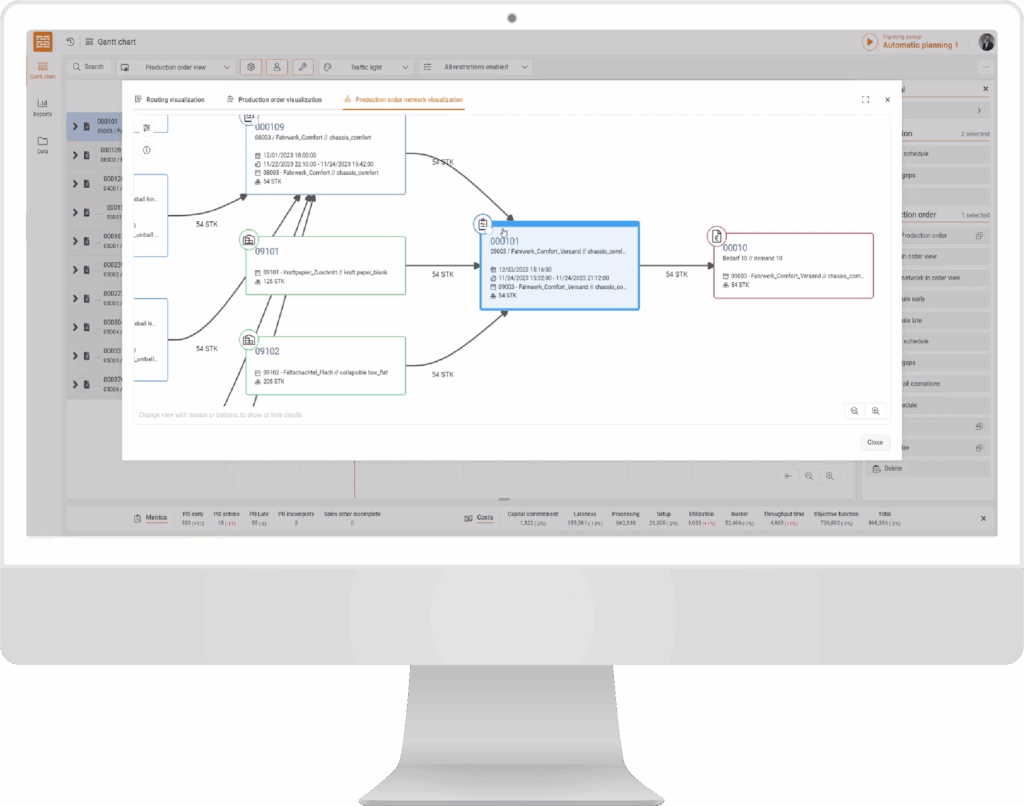
End-to-end value-chain planning for seamless workflows
Complete Material Requirements Planning to keep stock levels lean
Bottleneck-centred scheduling that smooths production flow
A foundation for energy-cost planning and AI-powered insights
Higher on-time delivery rates and shorter lead times
Reduced setup, production and personnel costs
Lower work-in-progress levels and better resource utilisation
Funktionen & Module
- Optimierungs-Engine
- MRP & ATP/CTP
- Personal- und PRT-Einsatzplanung
- Langfristige und taktische Planung
- Berichts- und Kontrollzentrum
- Koordination der Lieferkette
- Online-Rückmeldungen aus der Fertigung (MES/MOM)
- Produktionsfortschritt in Echtzeit
- Optimierungskriterien
- KI und bestärkendes Lernen
Ein leistungsstarker Terminplaner, der mehrere Ziele – wie die Minimierung von Rüstzeiten, die Senkung der Arbeitskosten und die Einhaltung von Lieferterminen – in Echtzeit miteinander in Einklang bringt. Führen Sie verschiedene Was-wäre-wenn-Szenarien parallel durch, um Pläne sofort miteinander zu vergleichen.
Vorteile:
Automatisiert Kompromissentscheidungen zwischen konkurrierenden Zielen
Hier können Sie sich eine Vorschau ansehen und mit einem Klick den besten Tarif auswählen
Umfassende Materialplanung mit Losgrößenregeln, hybriden Pull-Push-Strategien und Echtzeit-Verfügbarkeitsprüfungen zur Bestätigung der Lieferbarkeit vor der Auftragsannahme.
Vorteile:
Schlägt automatisch Einkaufs- und Fertigungsaufträge vor
Stellt sicher, dass Sie niemals zu viele Bestellungen annehmen oder einen Liefertermin verpassen
Ordnen Sie Aufgaben den Mitarbeitern und Werkzeugen nach Fähigkeiten, Abteilung oder Schicht zu. Verwalten Sie Abhängigkeiten zwischen Werkzeugsätzen und Wartungsfenstern, um Konflikte zu vermeiden.
Vorteile:
Stellt sicher, dass stets das richtige Personal und die richtige Ausrüstung bereitgestellt werden
Reduziert Leerlaufzeiten durch automatisierte Umschaltregeln
Wechseln Sie nahtlos zwischen strategischen, mittelfristigen und wöchentlichen Planungshorizonten. Stimmen Sie Ihren jährlichen Masterplan auf die Umsetzung in der Produktion ab.
Vorteile:
Unterstützt Kapazitäts- und Investitionsentscheidungen, die mehrere Monate im Voraus getroffen werden
Liefert detaillierte, wöchentliche Produktionspläne
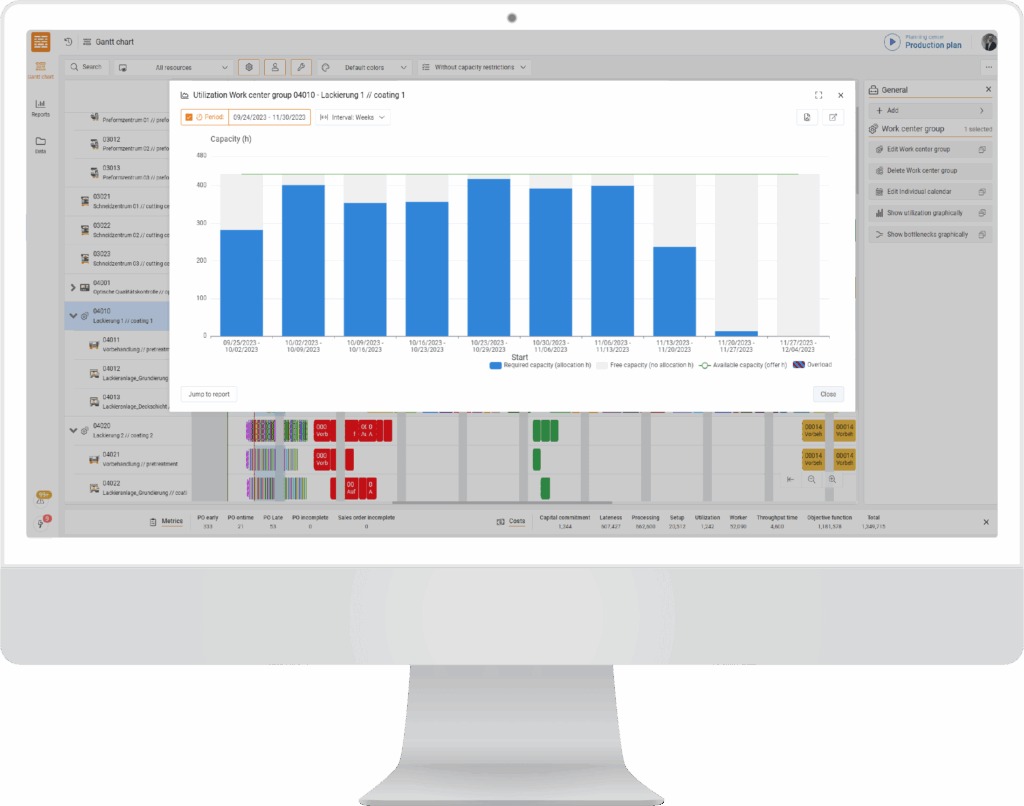
Ein Live-Dashboard-Hub mit individuell anpassbaren Diagrammen zu Auslastung, Engpässen und Termintreue. Sie können detaillierte Einblicke in beliebige Zeiträume oder Arbeitsstellen gewinnen.
Vorteile:
Bietet sofortigen Einblick in die Auswirkungen von Plänen
Ermöglicht datengestützte Anpassungen in Echtzeit
Koordinieren Sie Beschaffung, Produktion und Vertrieb in einem einheitlichen Zeitplan. Optimieren Sie Lagerumschläge und Transporttermine standortübergreifend.
Vorteile:
Stellt sicher, dass die Materialien zur richtigen Zeit am richtigen Ort sind
Gleicht die Auslastung zwischen Werken, Lagern und Spediteuren aus
Das System erfasst Echtzeitdaten direkt von den Maschinen und Mitarbeitern in der Fertigung. Diese Online-Rückmeldungen sorgen für Transparenz und Aktualität in Ihren Betriebsabläufen.
Vorteile:
Sofortiger Überblick über den aktuellen Produktionsstatus
Schnellere Reaktion auf Probleme, wodurch Ausfallzeiten reduziert werden
Produktionsfortschritt in Echtzeit
Bleiben Sie mit Live-Updates zum Auftragsfortschritt, zum Maschinenbetrieb und zu den Eingaben der Bediener stets auf dem Laufenden. Alles wird in Echtzeit erfasst und visualisiert.
Vorteile:
Bessere Kontrolle über Termine und Lieferpläne
Verbesserte Entscheidungsfindung auf der Grundlage aktueller Informationen
Optimierungskriterien
Unser APS-System nutzt individuell definierte Regeln und Vorgaben, um Produktionsabläufe und den Ressourceneinsatz zu optimieren. Die Planung orientiert sich an den für Ihr Unternehmen wirklich wichtigen Aspekten.
Vorteile:
Verkürzte Produktionszeit und weniger Ausschuss
Effizienterer Einsatz von Maschinen, Materialien und Arbeitskräften
Eine selbstlernende Engine, die ihre eigenen Regeln anhand historischer Daten und Echtzeitdaten verfeinert. Mit jedem Update werden die Zeitpläne immer genauer.
Vorteile:
Prognostiziert und verhindert Störungen, bevor sie auftreten
Verbessert die Planungsgenauigkeit im Laufe der Zeit kontinuierlich
Funktionsbereiche
Our Advanced Planning and Scheduling (APS) system supports a wide range of key functional areas to optimise production and planning processes. It includes tools for demand forecasting, production scheduling, and capacity planning, helping manufacturers respond effectively to changing market needs.
The system also covers material requirements planning (MRP), finite and infinite scheduling, and what-if analysis to evaluate different planning scenarios. With constraint management and order prioritisation, users can handle production limits and ensure timely deliveries. Scenario planning, Just-In-Time (JIT) scheduling, and supply chain synchronisation further enhance coordination across the entire manufacturing network.
Schlüsseltechnologien
APS systems today harness a range of key technologies to deliver truly responsive and optimised production plans. Finite-capacity scheduling ensures every machine and work centre is loaded within its actual limits, while AI/ML-based optimisation continuously learns from your data to suggest ever-better sequences. Digital twins replicate your shop-floor in a virtual model, enabling risk-free what-if scenarios and faster decision cycles.
Flexible deployment options—cloud, on-premises or hybrid—let you choose the right balance of control and scalability, and real-time data processing keeps schedules up to date as conditions change. Under the hood, powerful heuristic and genetic algorithms tackle complex trade-offs at speed, and constraint programming enforces every rule from tool availability to labour qualifications, so your plans are both ambitious and achievable.
Read further about the technology that Accevo uses.
Herausforderungen bei der Produktionsplanung
Effective production planning is essential for manufacturing efficiency, yet companies frequently encounter challenges such as limited transparency, rigid systems, scheduling complexities, communication issues, and hidden bottlenecks. These problems lead to inefficiencies, delays, and increased costs. To overcome these challenges, businesses should adopt advanced planning tools, flexible scheduling solutions, improved interdepartmental communication, data-driven analytics, and systematic knowledge management, ensuring better adaptability and competitiveness in production processes.
The top five challenges in production planning are:
Limited transparency across the value-added process
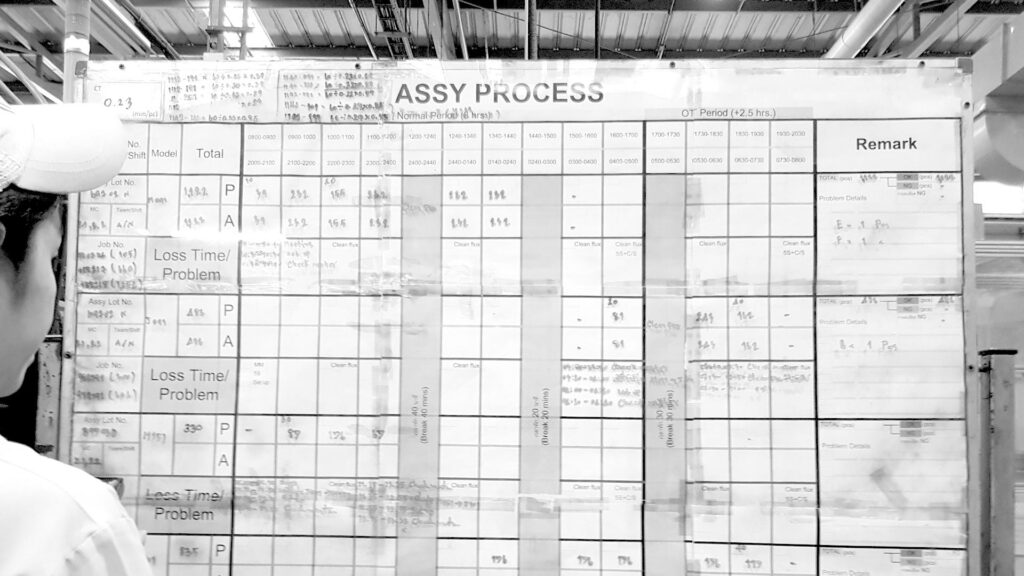
Rigid and outdated planning systems (like Excel)
Difficulty managing daily order scheduling
High communication effort between departments
Lack of visibility into production bottlenecks
Read further in the article Challenges in Production Planning.

Herausforderungen in der Produktionsplanung
Eine effektive Produktionsplanung ist für produzierende Unternehmen, die in einem sich schnell verändernden Markt wettbewerbsfähig, effizient und rentabel bleiben wollen, von entscheidender Bedeutung. Genaue und agile Produktionsplanung

Integrationen und zugehörige Systeme
Fully integrated with leading ERP systems such as SAP, Microsoft, Oracle, Infor, and Comarch, our solution ensures smooth data flow and synchronisation across the entire production process. This seamless integration supports efficient planning, execution, and monitoring between ERP, APS, and MES systems.
ERP
- Master and transaction data
- Personnel
- Work centers
- Production resources and tools
- Demands
APS
- Planning and optimization
- Gantt chart
- Order sequencing
- Consideration of constraints
- Analysis
MES
- Confirmations, machine and order state from
MES to Accevo APS - Shopfloor
Einhaltung von Vorschriften und Normen
ISA-95
ISA-95: Integration Standard between Enterprise and Control Systems
ISA-95 is a widely recognised international standard specifically designed to integrate business (enterprise) and manufacturing (control) systems. It provides a structured approach for data exchange between different operational levels, such as management and factory floor operations.
Improves Visibility and Transparency:
By standardising information flows, ISA-95 helps organisations gain clear visibility across the entire manufacturing process. This standard is crucial for identifying bottlenecks, reducing delays, and improving overall operational efficiency.Supports System Interoperability:
Companies employing ISA-95 experience smoother integration of Manufacturing Execution Systems (MES), Enterprise Resource Planning (ERP), and control systems. This interoperability is essential for dynamic production scheduling and real-time decision-making.Enhances Communication:
By standardising terminology and data formats, ISA-95 significantly reduces miscommunications and errors across departments, contributing to more efficient production planning.
Example: A pharmaceutical manufacturer using ISA-95 standards successfully integrates batch production data directly into its ERP system. This integration allows immediate adjustments based on demand forecasts, regulatory requirements, or production anomalies.
ISO 9001
ISO 9001 is an internationally accepted quality management standard focusing on consistent quality delivery, customer satisfaction, and continual process improvement.
Promotes Quality Assurance:
ISO 9001 provides a structured framework to ensure all production processes meet defined quality standards. It directly impacts planning by embedding quality checks into operational routines.Facilitates Risk Management:
By integrating preventive measures and regular audits, ISO 9001 helps identify potential issues in production processes before they escalate, aiding proactive planning and risk reduction.Encourages Continuous Improvement:
Implementing ISO 9001 promotes systematic tracking of performance metrics, enabling continuous improvements in production processes, resource management, and scheduling efficiencies.
Example: An automotive parts manufacturer certified with ISO 9001 systematically reviews production plans and quality metrics. This continuous monitoring ensures prompt action on discrepancies, reduces wastage, and improves production reliability.
Präsentation des Systems
Kontakt mit unserem Experten
Warum eine Demo anfordern?
- A 60-minute online meeting with a dedicated specialist presenting a top system from an industry similar to yours
- Live modeling of your production process
- A budget quotation after the meeting
Verwandte Artikel

Produktionsplanung in APS als Methode zur schnellen Reaktion auf die Prozessdynamik
Das APS-System ist ein fortschrittliches Werkzeug für die Produktionsplanung und die Reaktion auf Ereignisse, die in Echtzeit auftreten. Die Integration der Software mit anderen Management

Wie modelliert man den Produktionsprozess in MES?
Die erfolgreiche Implementierung von MES hängt von mehreren Faktoren ab - von der korrekten Implementierung der zu erfassenden Daten bis hin zur genauen Analyse der Informationen.

Herausforderungen in der Produktionsplanung
Eine effektive Produktionsplanung ist für produzierende Unternehmen, die in einem sich schnell verändernden Markt wettbewerbsfähig, effizient und rentabel bleiben wollen, von entscheidender Bedeutung. Genaue und agile Produktionsplanung