System MES - Fertigungsausführungssystem

Messen und analysieren Sie Ihren Produktionsprozess mit dem MES-System und zeigen Sie Verbesserungspotenziale auf.

Erhöhung der Betriebszeit
0 %
gebackene Kekse monatlich
0 %
weniger Materialverbrauch
0 %
Zeitersparnis beim Umrüsten
0 %

Was ist ein Manufacturing Execution System (MES)?

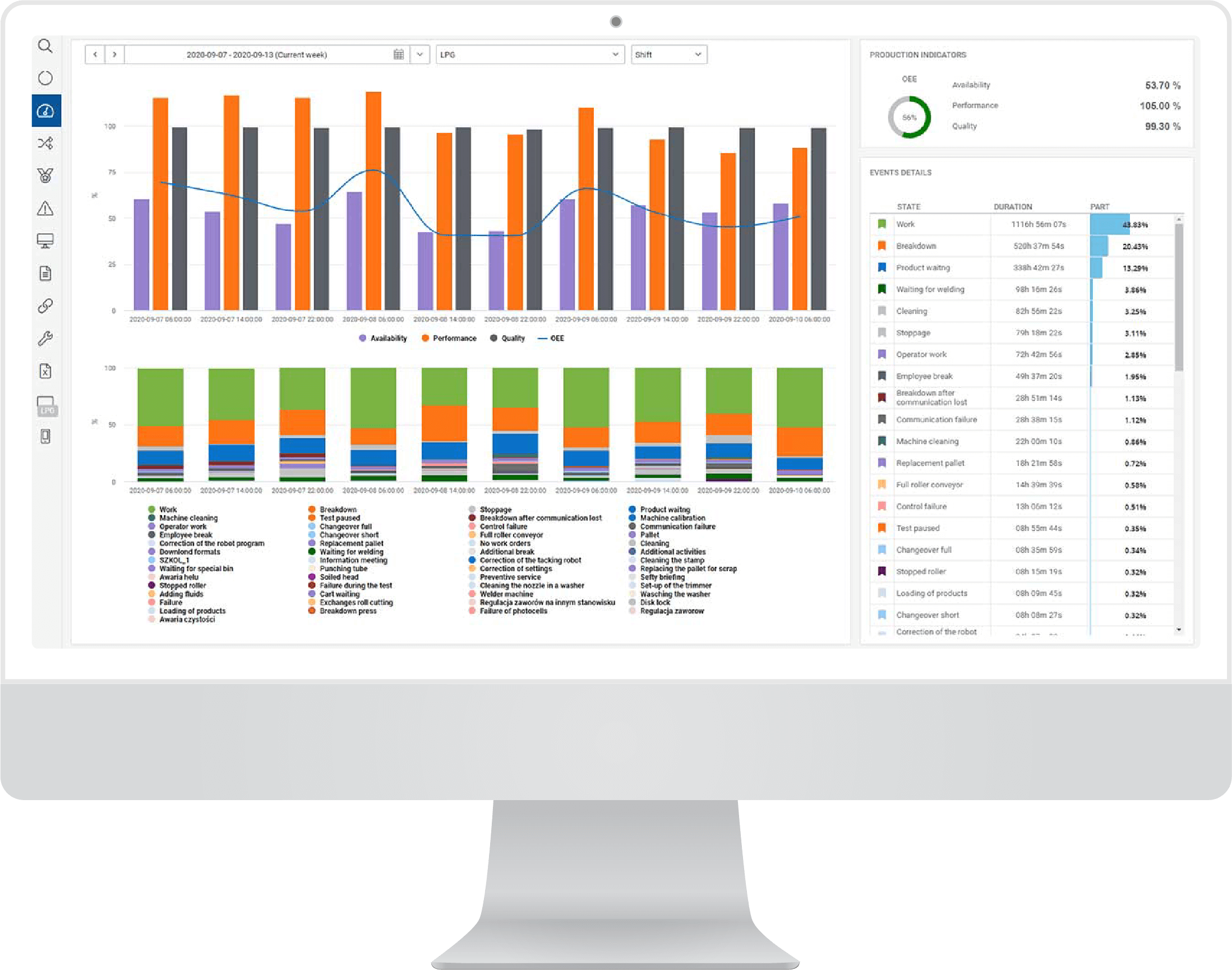
MES System is a manufacturing efficiency and execution platform that allows for the collection of data from the machines, or entire production line, analysing and displaying them in a user-friendly manner. MES software is implemented to make operators’ jobs more predictable and help managers undertake more insightful decisions for faster and better production. 

  • Provides a comprehensive overview of production analytics.
  • Identifies underperforming processes and malfunctions.
  • Enables correction of root issues for improved productivity and resource allocation.
  • Aids in quality control to maintain industry compliance.
  • Minimises product defects for consistent excellence in manufacturing.
  • Streamlines communication within the organisation.
  • Helps reduce downtime, increasing plant effectiveness.

Die Situation in Deutschland

Der deutsche Produktionssektor steht vor zahlreichen Herausforderungen, wie verfügbare Daten und Berichte zeigen. Viele Unternehmen setzen noch immer auf manuelle Planung mit Excel, was zu Fehlern und Verzögerungen führt. Die mangelnde Integration verschiedener Systeme erschwert effiziente Abläufe.

Ungeplante Stillstände verursachen laut einem Siemens-Bericht aus 2024 bis zu 11 % Umsatzverluste jährlich – weltweit entspricht das etwa 1,4 Billionen US-Dollar. Auch die Qualitätssicherung ist betroffen: In Deutschland stieg die Zahl der Lebensmittelsicherheitswarnungen von 24 im Jahr 2011 auf 267 im Jahr 2023. Rückverfolgbarkeit bleibt oft unzureichend. Trotz Deutschlands führender Rolle in der Automatisierung nutzen nur 17 % der Firmen KI-basierte Lösungen, während 40 % deren Einführung lediglich planen. Hinzu kommen strukturelle Probleme: hohe Energiekosten, Fachkräftemangel und Konkurrenz aus Asien.

Seit 2018 sank die industrielle Produktion um 15 %, die Beschäftigung im Produktionsbereich ging um 3 % zurück. Insgesamt zeigen diese Entwicklungen den dringenden Bedarf an Digitalisierung, Systemintegration und Investitionen in moderne Technologien, um die Wettbewerbsfähigkeit langfristig zu sichern.

Was ist der Unterschied zwischen MES und ERP?

The difference between Manufacturing Execution Systems (MES) and Enterprise Resource Planning (ERP) systems lies in their core functionalities, focus areas, and operational scope within an organization. While both systems are pivotal in modern business management and aim to increase efficiency and streamline operations, they serve distinct roles within an enterprise.

Merkmal
MES (Manufacturing Execution System)
ERP (Unternehmensressourcenplanung)

Schwerpunkt

Spezifisch für Fertigungsprozesse und Arbeitsabläufe in der Werkstatt

breit angelegt, integriert verschiedene Geschäftsprozesse in der gesamten Organisation

Primäre Zielsetzung

Optimierung und Überwachung von Produktionsprozessen in Echtzeit

Rationalisierung und Integration aller Geschäftsabläufe

Zentrale Funktionen

Produktionsverfolgung in Echtzeit, Qualitätskontrolle, Maschineneffizienz

Finanzmanagement, Lieferkettenmanagement, HR, CRM

Umfang

Operative Kontrolle auf der Produktionsebene

Strategisches Management und Planung auf Organisationsebene

Datenverarbeitung

Detaillierte, operative Daten mit Schwerpunkt auf der Fertigung

Aggregierte Daten über verschiedene Geschäftsfunktionen hinweg

Benutzerbasis

Hauptsächlich von Produktionsleitern und Mitarbeitern in der Fertigung verwendet

Wird von verschiedenen Abteilungen wie Finanzen, Personalwesen, Vertrieb usw. genutzt.

Auswirkungen

Unmittelbare Auswirkungen auf die Produktionseffizienz und die Produktqualität

Beeinflusst die Effizienz des gesamten Unternehmens, die Ressourcenzuweisung und die strategische Planung

Welche Probleme löst das MES-System von Accevo ?

Edit Content
  • Production stoppages. 

  • Lack of knowledge about the current progress and work of production.

  • Waste of paper, difficulty maintaining versioning and access to documents.

  • Long production start-up times.

  • Human errors.

  • Inadequate reporting on performance data.

  • Unable to take proactive decisions on problems and solutions. 

  • Ineffective process control and failure to meet customer expectations.

Edit Content
  • Production not shipped on time.

  • Inability to identify bottlenecks in the production process.

  • Manual production planning, planning in Excel.

  • Not sure that I have all the resources to produce.

  • Poor tracking of production and production order fulfilment.

Edit Content
  • Uncontrolled production of defects.

  • Inadequate traceability of production processes.

  • Too many scrap and defects.

  • Manually generated SPC reports.

Edit Content
  • Lack of immediate information about the failure in the maintenance department.

  • Too much downtime.

  • No windows available for inspections and repairs.

Edit Content
  • Lack of system integration 

  • Multiple systems across one. facility instead of one. 

  • Lost access to the prodution system.

Edit Content
  • There is no data to make a good decision. 

  • Lack of control over the implementation of production.

  • The need to work on additional shifts due to the failure to cope with the current production. 

The software can lead to the identification of more than 200 processes from the shop floor to the warehouse to get rid of or to simplify, e.g. quality documentation forms with redundant information. Step by step, combining small changes can add up to considerable improvement potential. Properly adresssed issues can lead to time savings reduction ranging from 10 minutes up to 2 hours. Not only it helps to reduce the burden for employees in production but also for those surrounding work areas involved in cross-divisional processes. 

Welche Module und Funktionen hat das Accevo MES System?

  • Machine communication with standard TCP and native PLC protocols (OPC DA/UA, Siemens and more)
  • Read data from the automation level: production counters, machines status, process parameters
  • Data buffering if connection lost to preserve all information
  • Start production in a planned sequence, use RFID cards to access the system
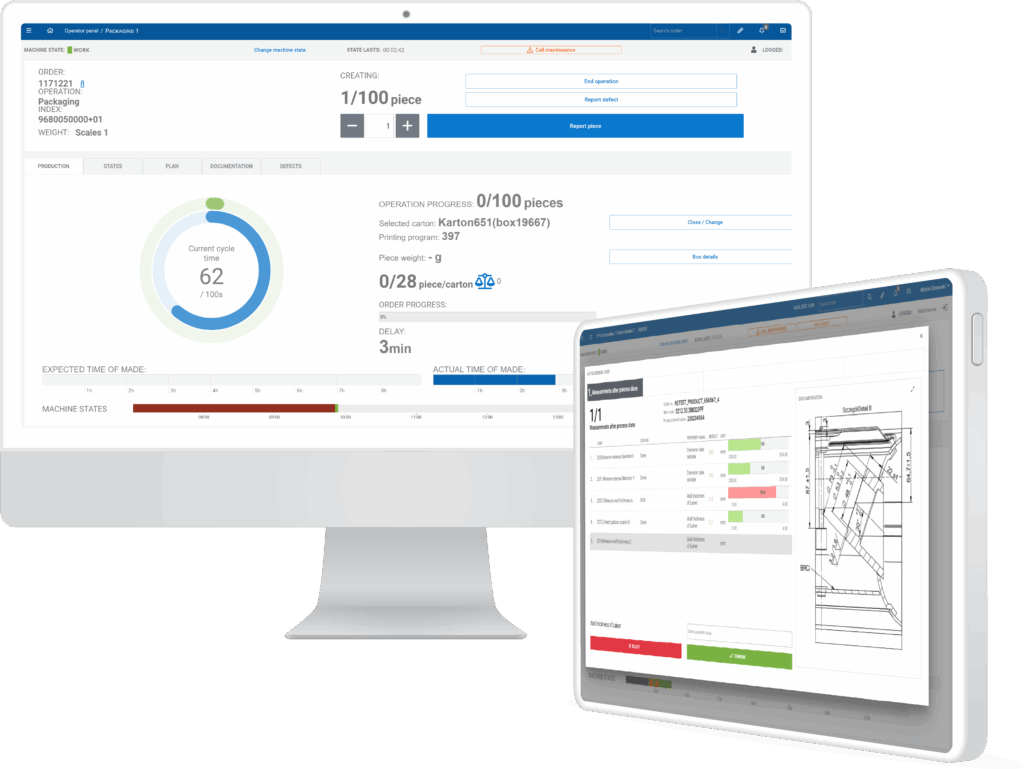
  • Display progress, main KPIs and current delay for ongoing production
  • Manual or automatic production reporting with machine states
  • Recurring events automatically request quality inspection thanks to triggers
  • Automatic feedback for the operator (quality limits)
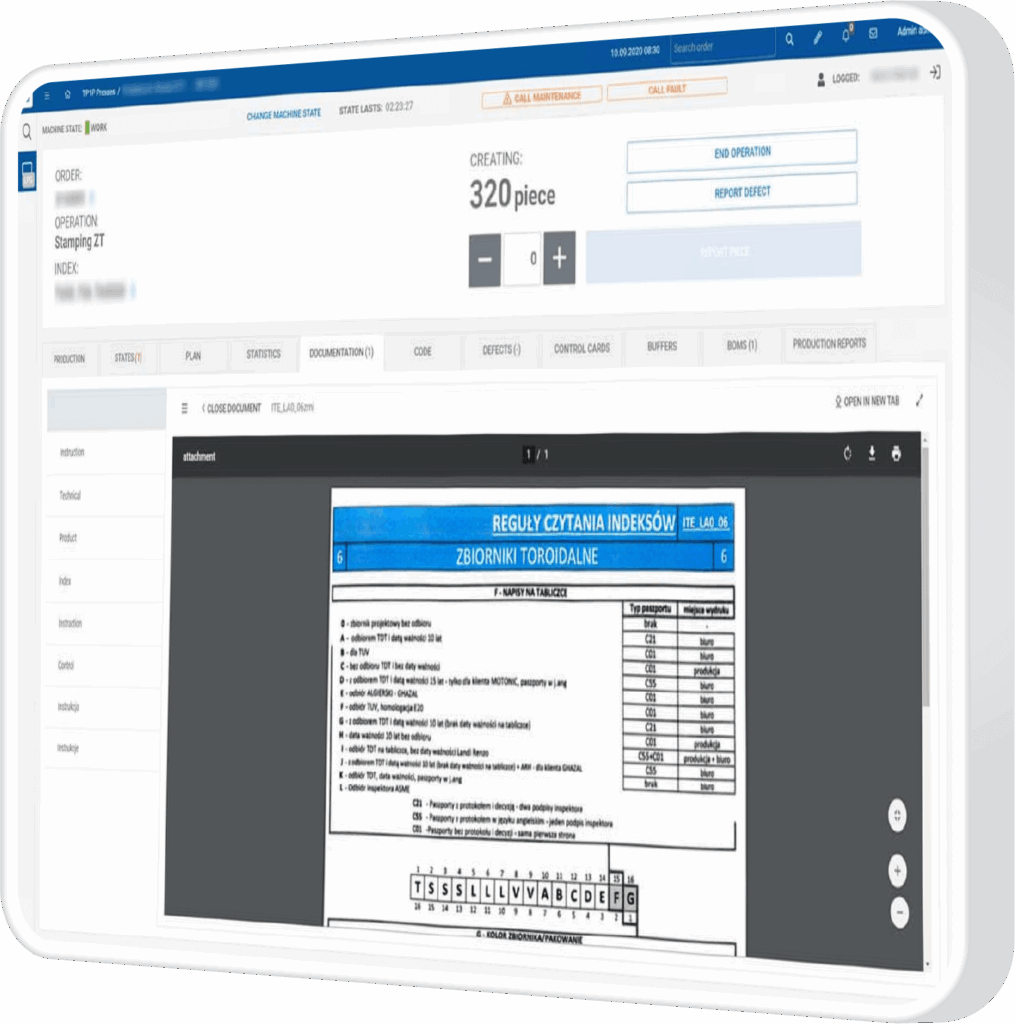
  • Dedicated instruction and documentation
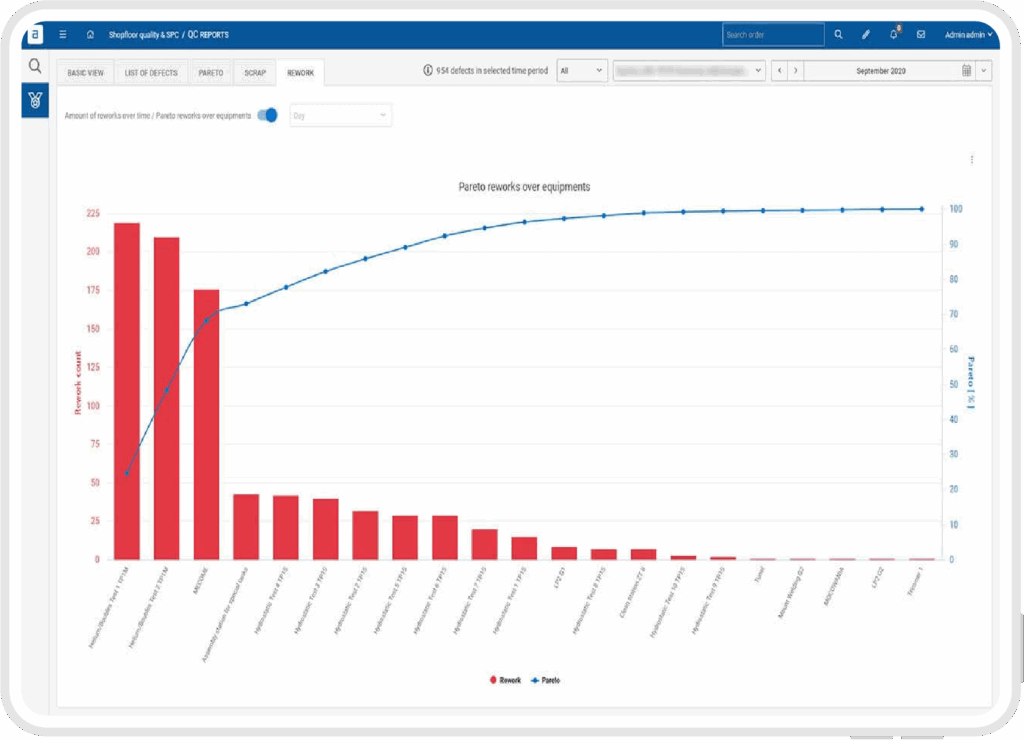
  • Automatically generated quality reports: SPC, Shewhart control charts
  • Manual or automated defect reason reporting
  • The decision to report defects or scrap
  • Reporting defects for components
  • Starting rework production by scanning the rework label or choosing special rework order
  • Automatic validation and guiding via rework technology
  • Configure rework flow for reported defect reason
  • Various reports for production, machines, quality
  • Dashboard for ongoing production
  • Various angles for data analytics
  • Transparent overview of all areas
  • Top-to-bottom analysis
  • Dedicated dashboards for most important analysis
  • Display digital documentation for Operator (PDF, images, movies)
  • Documentation categorization like changeovers, quality control, maintenance
  • Demand the read confirmation upon the newest version
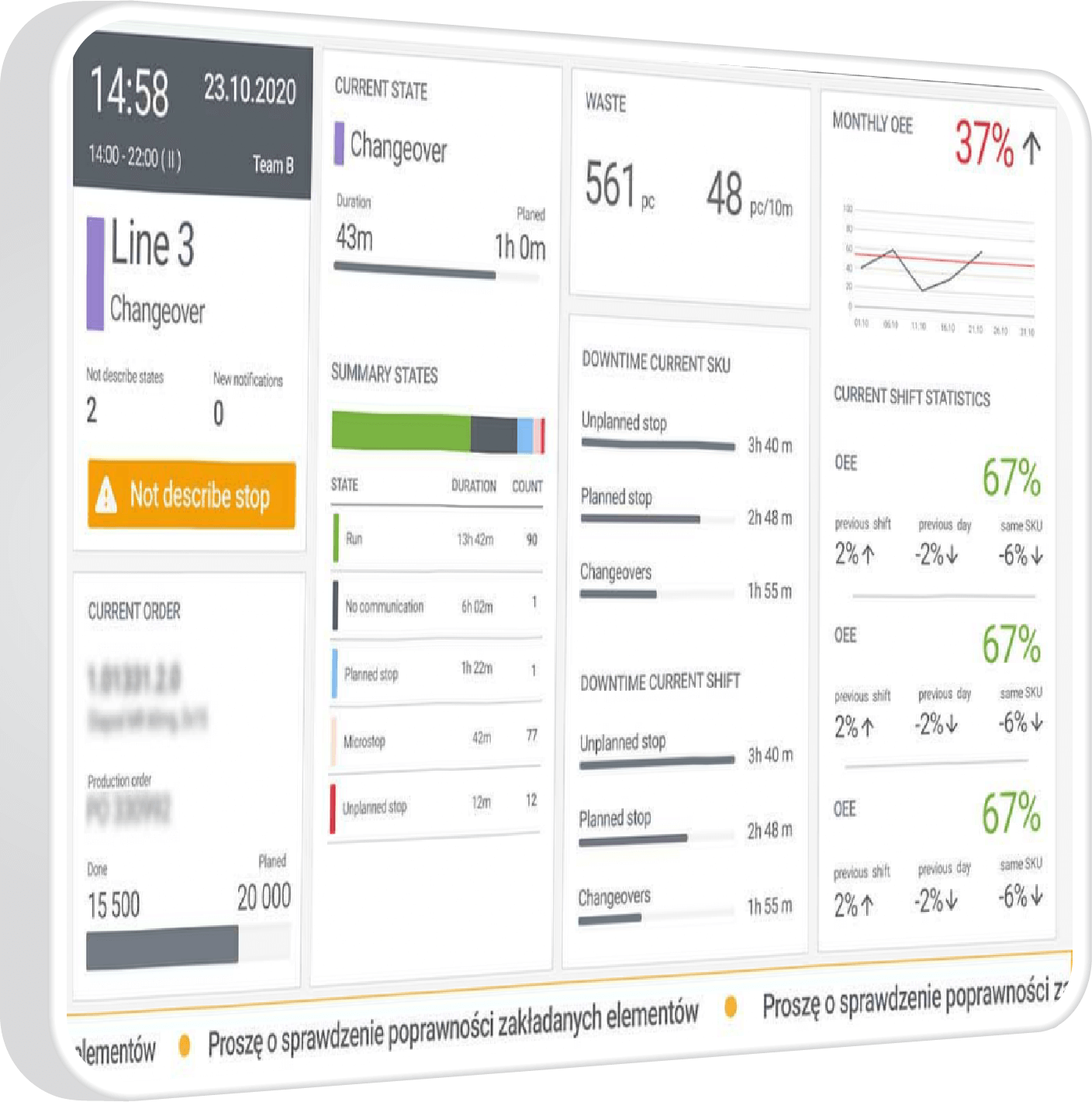
  • Display production summary for selected machines
  • Display the current shift’s OEE and production delay
  • Real-time data update based on reports or machine’s cycles
  • Failures reporting with its reason and comment
  • Maintenance failure acceptance and its ending
  • Reaction time, repair time and its KPIs monitoring (MTTR, MTBF, MTTF)
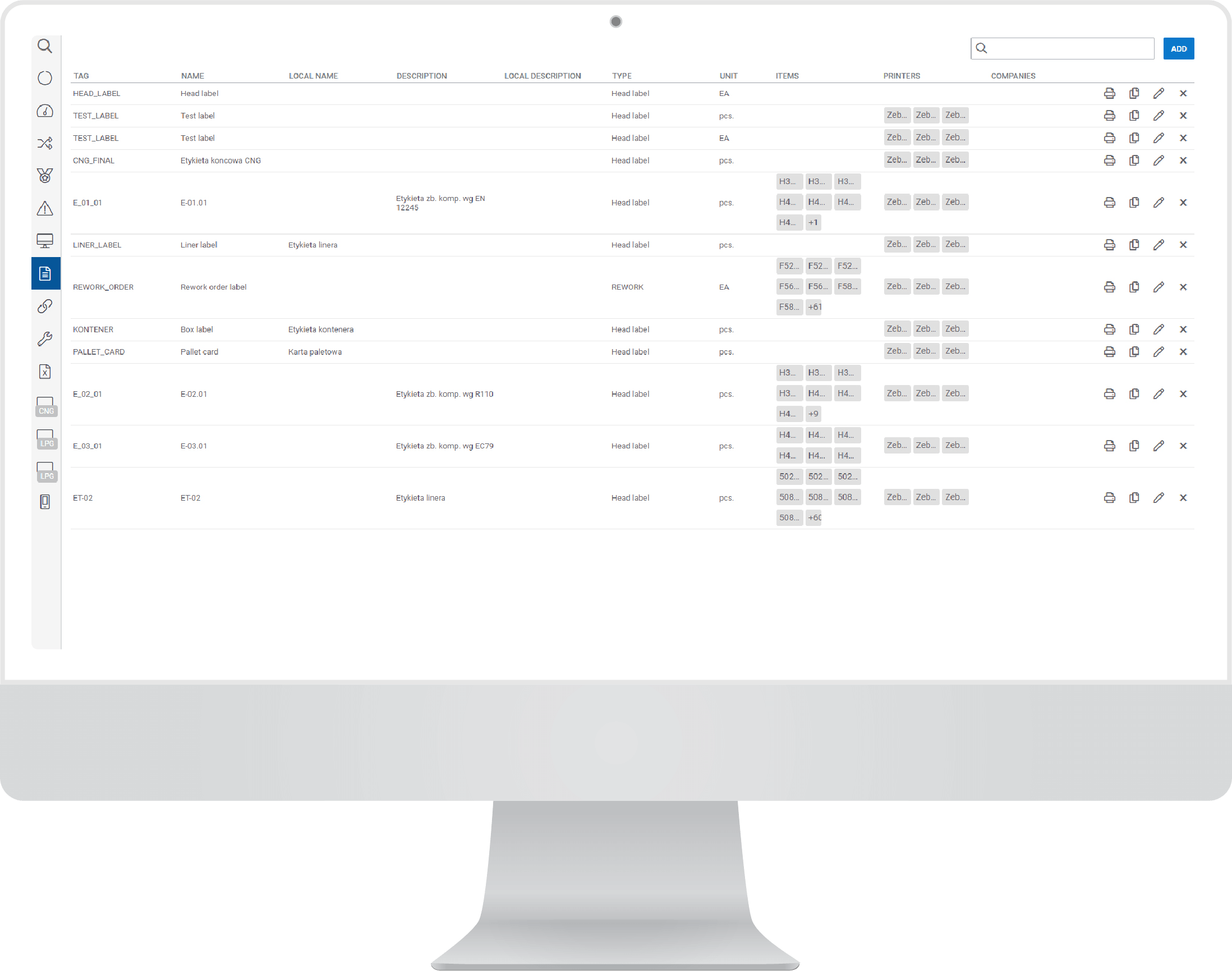
  • Basic production data modeling: items, routings, factory structure
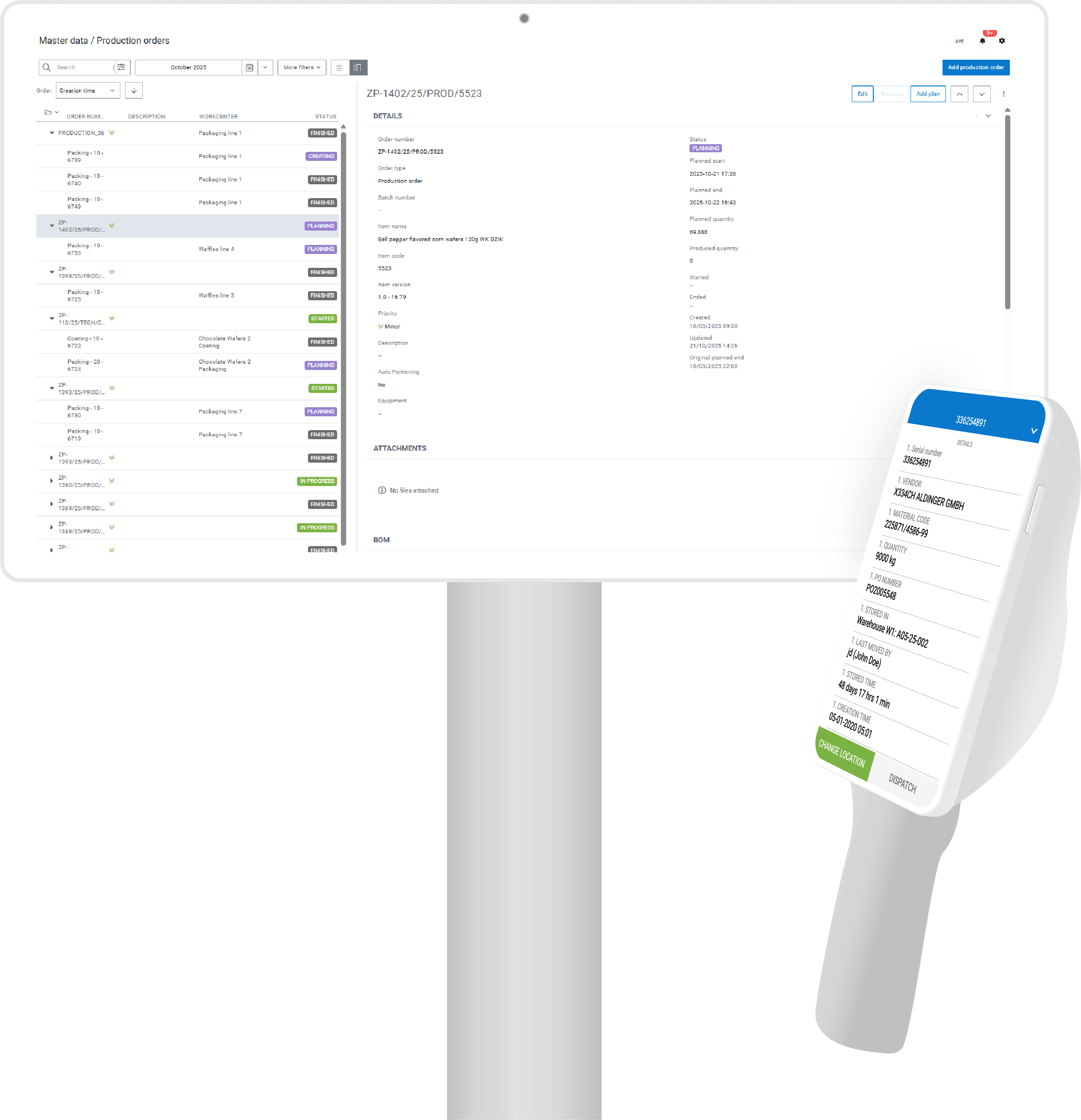
  • Managing production orders, defects, documentation
  • Managing KPI thresholds, production targets or machine states
  • Scanning resources to match components and tools with production.
  • Additional validation
  • Automatic serialization and labeling printing for done production

Materiallogistik (Shop Floor WMS)

  • Tracks inventory – Monitors stock levels in real-time.
  • Speeds up orders – Optimizes picking, packing, and shipping.
  • Integrates systems – Connects with ERP and production.

Stücklisten-Validierung

  • Checks accuracy – Verifies BOM components and quantities.
  • Prevents errors – Detects missing or incorrect parts.
  • Ensures consistency – Aligns BOM with production requirements.

Label-Verwaltung

  • Generates labels – Creates accurate product labels.
  • Ensures compliance – Meets industry standards.
  • Tracks items – Improves traceability and identification.

Hinterlassen Sie Ihre E-Mail-Adresse, um ein Angebot zu erhalten

Was sind die wichtigsten Vorteile von MES-Software in der Produktion?

oee-erhöhen

OEE & OTIF-Steigerung

✔️ voraussichtliches Datum und Uhrzeit der letzten Position im Produktions-/Verkaufsauftrag
✔️ weniger und schnelleres Umrüsten
✔️ schnellere Ausführung von Produktionsaufgaben

mängelfrei

Weniger Mängel

✔️ schnellere Fehlererkennung und Nacharbeitsmanagement
✔️ SPC und zustandsorientierte Überwachung
✔️ periodische Qualitätspläne

Rückverfolgbarkeit

Traceability

✔️ Stücklistenvalidierung (Artikelprüfung, wenn QC-Freigabe)
✔️ Überwachung des Lebenszyklus der Werkzeuge
✔️ stromaufwärts und stromabwärts

Was sagen unsere Kunden über das Accevo MES-System?

Zitat-Symbol

Manufacturing in the region for the region, next to our customers is a pillar of our operations strategy.

We invested massively in our factories over the last years to increase capacity; completing these investments with the best digitalization solution of all manufacturing systems is a key part of our program toward more efficiency and agility. In a great collaboration with Accevo, we are rolling out our plans.

Fabrice Revert, COO
LinkedIn

Viererpack
Zitat-Symbol

OEE, production and quality monitoring is very precise and automatic. The process optimisation is less time consuming and problems are faster and easier to detect.

Accevo managed to custom the MES interface and its funcionalities to a high degree so that we could really make the most out of the system

Veronica Ottonello, Industrial Process Engineer at Bormioli Pharma
LinkedIn

Bormioli-Pharma-Logo
Weiterempfehlungswahrscheinlichkeit 90%

Mehr lesen

Cloud-Fertigung BG 2025 Web

Cloud Manufacturing MES

Cloud Manufacturing Ein sicherer Ort für alle Ihre Produktionsdaten Was ist Cloud Manufacturing? Cloud Manufacturing ist die Anwendung von Cloud Computing in der Fertigung. Sie

Mehr lesen "

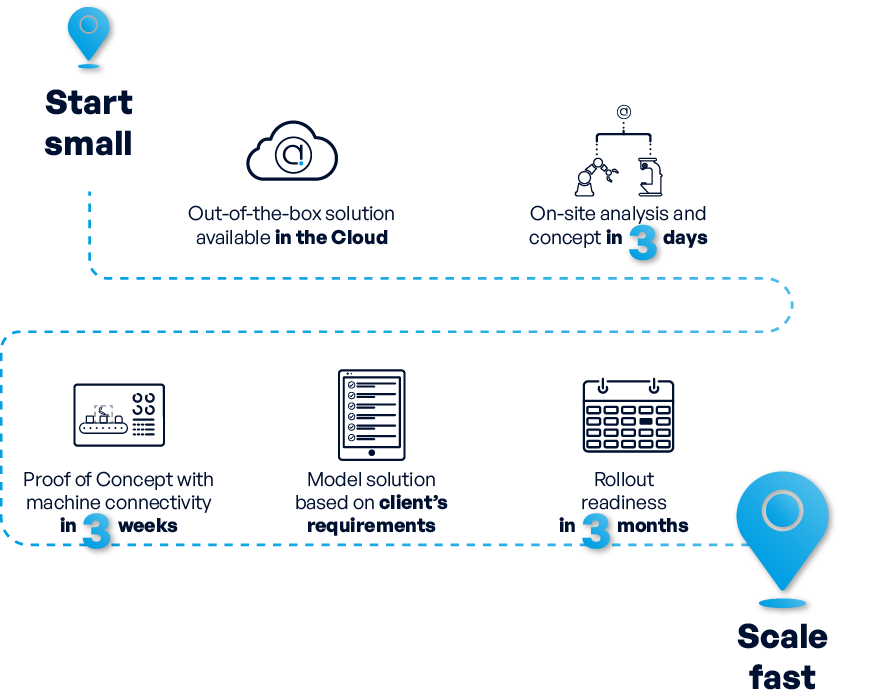
Wie schnell kann ein MES-System eingeführt werden?

Diagramm, das den Implementierungsprozess der Lösungen von Accevo veranschaulicht und dabei Phasen wie den kleinen Einstieg, die Analyse, den Proof of Concept, die Modellbereitstellung und die Skalierung hervorhebt.

Warum Accevo?

Accevo is an independent software provider for modern manufacturing. Our solutions are designed to make production facilities more flexible, adaptable, and efficient. The software enables real-time visibility into your operations and facilitates collaboration between people, data, and systems so that you can spend less time on operational tasks and more time on innovation.

  • Various products in a single scalable platform
  • Integration with all existing systems
  • Connectivity to all machines
  • Business-lnow-how and tehnical knowledge
erfolgreiche Implementierungen
+ 0
Länder
0
Jahre auf dem Markt
0

Präsentation des Systems

Kontakt mit unserem Experten

Piotr Kanka

Piotr Kańka

Industrial Software Expert

LinkedIn

Warum eine Demo anfordern?

  • A 60-minute online meeting with a dedicated specialist presenting a top system from an industry similar to yours
  • Live modeling of your production process
  • A budget quotation after the meeting

Ist es der richtige Zeitpunkt, ein MES-System in Betracht zu ziehen?

We can suggest several indicators suggest it’s the right time to consider implementing an MES:

  1. Growing Production Complexity: As production lines become more intricate and diversified, an MES can streamline operations, ensuring that every step is optimized and interconnected.
  2. Demand for Real-time Data: In an era where data drives decisions, having real-time insights into your manufacturing processes can be a game-changer. MES provides this data at your fingertips, enabling faster, more informed decisions.
  3. Quality Control Concerns: If maintaining consistent product quality is becoming a challenge, MES can offer tools to monitor and ensure quality throughout the production process.
  4. Scalability Needs: For businesses looking to expand or diversify, an MES system can seamlessly integrate new production lines or processes, ensuring that growth doesn’t compromise efficiency or quality.
  5. Regulatory and Compliance Pressures: Many industries face stringent regulatory requirements. MES systems can help ensure compliance by providing traceability, reporting, and documentation tools.

Further reading: Why OEE drops after MES implementation?

Where Accevo MES System can be implemented?

  • Modern MES software benefits all production industries.
  • Accevo has implemented systems in FMCG, Pharma, Automotive & Aviation, and High Volume Production.
  • Provides clear results and transforms production processes towards Industry 4.0.

Verwandte Artikel

Der Preis eines professionellen MES System hängtvon der ausgewählten Liste der Funktionalitäten, Integration mit Maschinen und erforderliche Ausrüstung (d. h.e. Drucker, Scanner und Computer). Die Gesamtkosten kosten werden abhängen von den Bedürfnissen des Unternehmens und die Anzahl von Maschinen das dasszu sein verbundenzu seinerreichenGeschäftsergebnisseErgebnisse. Das MES-System ist unlimited, modular und skalierbar, und ist nicht gebundenan einen bestimmten Anzahl von Benutzer oderGeräte, und kann daherangepasst werdenanzu die Bedürfnisseder von einem Unternehmen.


Wie lange die Einführung einer MES-Software dauert, hängt vom jeweiligen Unternehmen ab. Manche Unternehmen können sie in 3 Monaten einführen, andere in 6 Monaten. Die benötigte Zeit hängt auch davon ab, wie viele Daten aus den Prozessen des Unternehmens gesammelt werden müssen und wie viele Mitarbeiter für die Nutzung des neuen Systems geschult werden müssen. Ein erster Kostenvoranschlag und ein Konzept für die Lösung können bereits 3 Tage nach der Besprechung vorgelegt werden. PoC (Proof of Concept) 3 Wochen, einschließlich des Anschlusses der Maschinen, und eine vollständige Einführung des Systems in der Fabrik kann nach 3 Monaten erfolgen. 



Produkte Vergleichen

Wonach suchen Sie?

Hallo, anscheinend sind Sie an Software für die Produktion interessiert...

Abonnieren Sie unseren Newsletter und Sie erhalten unsere Broschüre.

By providing your email and clicking the “Download a catalogue” button, you agree to receive our newsletter.