












什么是高级计划与排程(APS)系统?
An APS system is software designed to tackle operational planning challenges in production, logistics and supply chain management. It works alongside ERP systems to plan across long, medium and short-term horizons, simulating multiple scenarios in real time to optimize throughput, reduce lead times, manage inventory and improve delivery performance. APS software can help in each industry replacing simple excel files and improving general manufacturing performance.
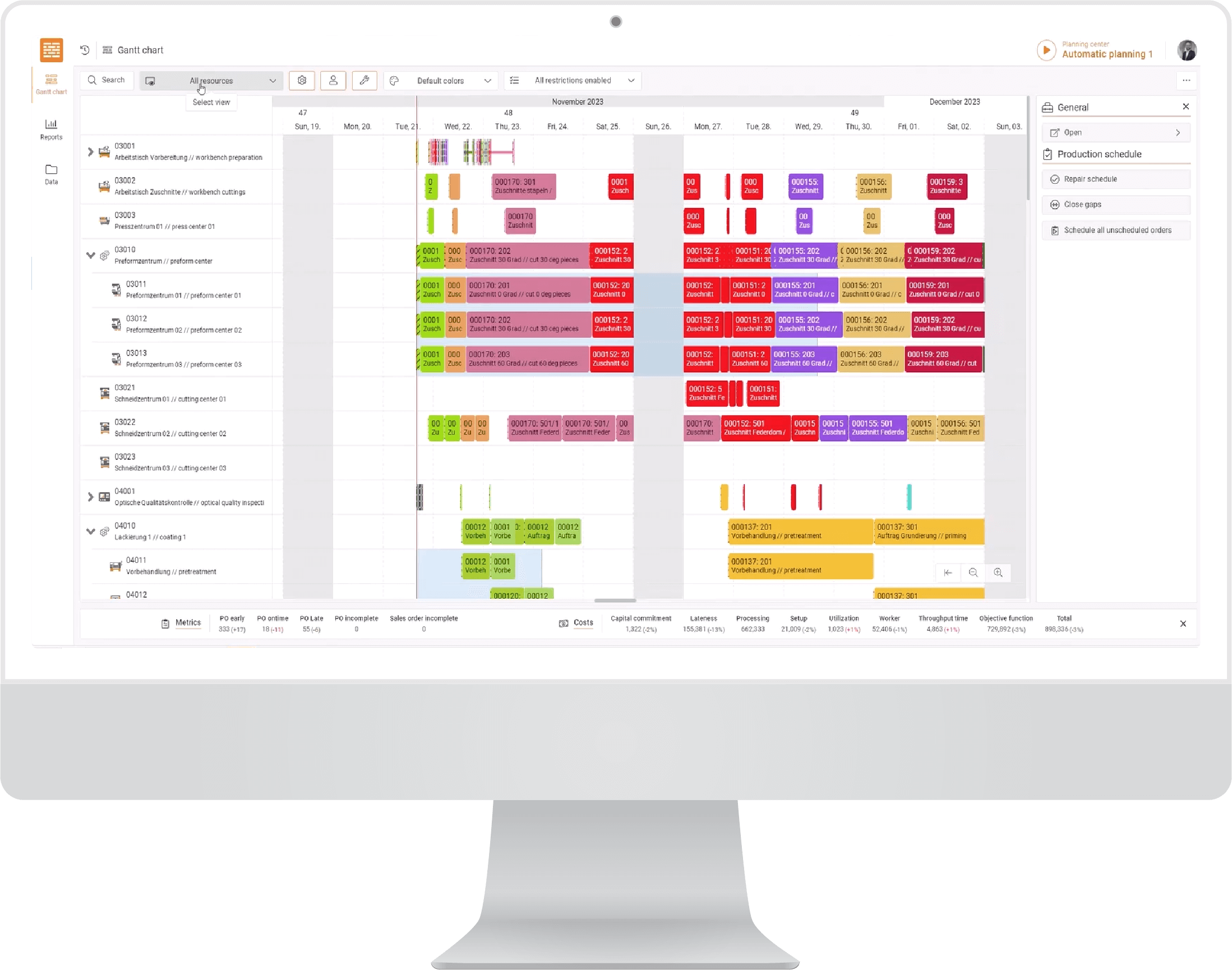

APS acts as the dynamic link between your high-level planning (ERP/SCM) and the realities on the shop floor. By ingesting real-time production data from ERP systems and sending back optimised production plans, APS transforms static schedules into agile, responsive workflows. In practice, this means you can reduce lead times, improve resource utilisation and keep your strategic goals aligned with what’s actually happening in production.
涵盖的行业
制造业(离散型、流程型、批量型)
Optimises production by reducing bottlenecks and managing capacity and materials.
汽车
Enables just-in-time scheduling and adapts to complex, changing supply chains.
餐饮
Schedules for freshness, allergen control, and ingredient availability.
航空航天
Manages long lead times, complex assemblies, and traceability.
制药
Supports compliance, batch tracking, and expiry-based planning.
快消行业
Handles fast-changing demand, short shelf life, and minimises waste.
纺织品
Deals with frequent order changes, colour variants, and machine planning.
电子产品
Supports fast product changes and limited capacity with agile scheduling.
什么时候才需要考虑使用APS软件?
Consider implementing an APS when your production plans become too complex for spreadsheets or manual methods to handle reliably. If you find yourself juggling multiple machines, materials and staff shifts—and struggling with late orders, bottlenecks or excess stock—an APS brings clarity and control. By running real-time simulations and optimizing every resource against your priorities, you can react quickly to changes in demand, avoid costly downtime and keep deliveries on track.

Intelligent Scheduling
Automatically sequence tasks to make the best use of machines and people, cutting idle time and speeding up delivery.
Solves: chaos from manual job sequencing and unexpected bottlenecks.

Material & Resource Planning
Ensure you have the right parts, tools and staff in place by matching material availability and capacity to your production needs.
Solves: costly stock-outs, over-ordering and unbalanced workloads

Live What-If Scenarios
Run instant simulations of changes—like rush orders or machine breakdowns—to see the impact and adjust your plan before issues arise.
Solves: the inability to foresee disruptions and adapt in time.
为什么选择 Accevo 的 APS 系统?
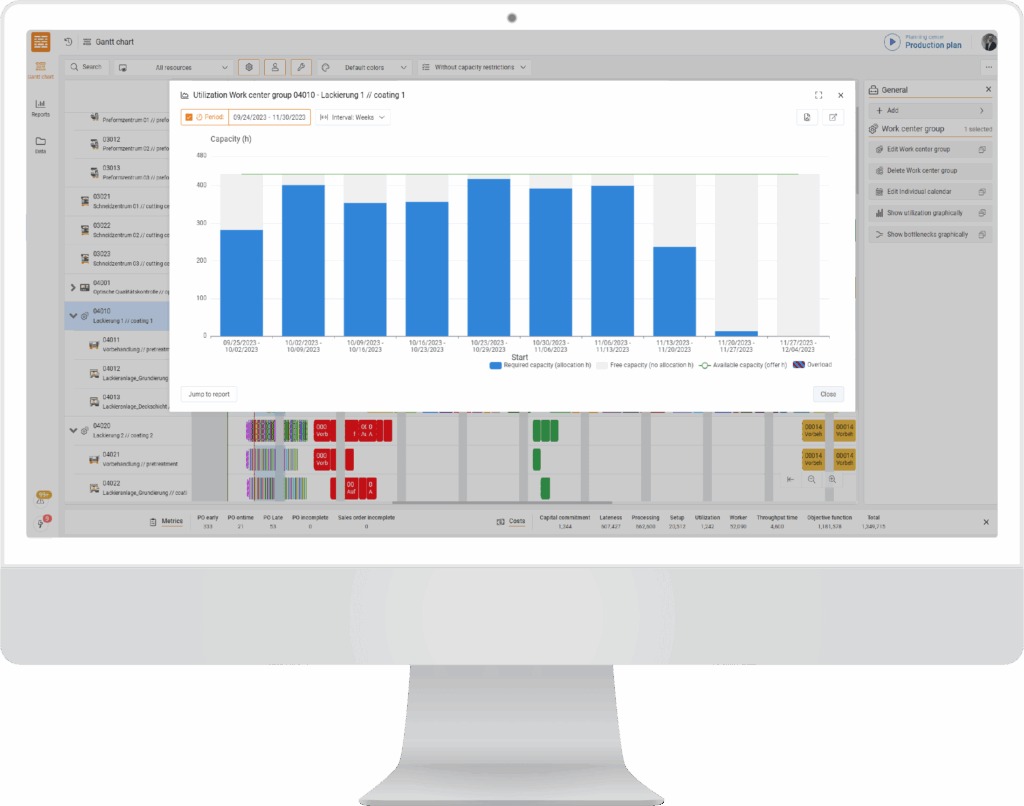
Choose Accevo APS because it brings together powerful optimisation, deep MRP and real-time AI in one easy-to-use, web-based planner. You’ll benefit from multi-criteria scheduling that balances priorities like setup times, labour costs and delivery dates, plus built-in forecasting and promise-checks to keep stock lean and customers happy. Our skill-based workforce module and full tool-set management ensure the right people and equipment are always in place. With interactive dashboards, what-if simulations and seamless ERP/CMMS/WMS integration via REST APIs, Accevo APS gives you the control to react instantly to change and drive continuous improvement.
Powerful optimisation engine for faster, smarter scheduling
Deep MRP with built-in forecasting and ATP/CTP checks
Real-time AI learning for ever-more accurate plans
Multi-criteria scheduling (setup times, labour costs, delivery dates)
Skill-based workforce and full tool-set management
Interactive dashboards and instant what-if simulations
Seamless ERP/CMMS/WMS integration via REST APIs
Web-based planner for access anywhere, no client install needed
According to our clients, the implementation of the Accevo APS system enjoy:
Flexible cost-based optimisation with multiple target criteria
End-to-end value-chain planning for seamless workflows
Complete Material Requirements Planning to keep stock levels lean
Bottleneck-centred scheduling that smooths production flow
A foundation for energy-cost planning and AI-powered insights
Higher on-time delivery rates and shorter lead times
Reduced setup, production and personnel costs
Lower work-in-progress levels and better resource utilisation
功能与模块
一款功能强大的排程系统,能够实时平衡多个目标——例如缩短换线时间、降低人工成本以及确保按时交付。您可以并行运行多种假设情景,即时比较不同方案。.
效益:
在相互竞争的目标之间自动进行权衡决策
让您一键预览并选择最适合的方案
通过批次规模规则、混合拉推策略以及实时可承诺交货量核查,进行深度物料规划,以便在接单前确认交付可行性。.
效益:
自动生成采购订单和生产订单
确保您不会超额承诺库存或错过交货日期
根据技能、部门或班次,将任务分配给相应的人员和工具。管理工具集的依赖关系和维护时段,以避免冲突。.
效益:
确保始终配备合适的人员和设备
通过自动切换规则减少闲置时间
在战略规划、中期规划和周度规划之间无缝切换。将年度总体规划与车间执行工作相协调。.
效益:
支持提前数月制定产能和投资决策
提供详细的每周生产计划
一个实时仪表盘中心,提供可自定义的图表,用于展示设备利用率、瓶颈及准时率。可深入查看任意时间段或工作中心的数据。.
效益:
可即时了解计划的影响
支持实时进行数据驱动的调整
在统一的计划中统筹采购、生产和分销。优化各站点之间的库存调拨和运输时段。.
效益:
确保物料在正确的时间送达正确的位置
在工厂、仓库和承运商之间平衡货运量
该系统直接从车间的设备和操作人员处收集实时数据。这种在线反馈确保您的运营透明且信息实时更新。.
效益:
即时掌握当前生产状态
更快地响应问题,减少停机时间
实时生产进度
通过实时更新,随时掌握订单进度、设备运行状况及操作员操作信息。所有信息均在发生时被实时追踪并可视化呈现。.
效益:
更好地掌控截止日期和交付时间表
基于最新信息,优化决策
优化准则
我们的APS系统采用自定义规则和约束条件,以优化生产顺序和资源利用率。规划工作完全基于对贵企业真正重要的因素。.
效益:
缩短生产时间并减少浪费
更有效地利用机器、材料和劳动力
一款能够根据历史数据和实时数据不断优化自身规则的自学习引擎。每次更新都能生成更加精准的日程安排。.
效益:
在问题发生前进行预测并加以防范
随着时间的推移,不断提高规划的准确性
职能领域
Our Advanced Planning and Scheduling (APS) system supports a wide range of key functional areas to optimise production and planning processes. It includes tools for demand forecasting, production scheduling, and capacity planning, helping manufacturers respond effectively to changing market needs.
The system also covers material requirements planning (MRP), finite and infinite scheduling, and what-if analysis to evaluate different planning scenarios. With constraint management and order prioritisation, users can handle production limits and ensure timely deliveries. Scenario planning, Just-In-Time (JIT) scheduling, and supply chain synchronisation further enhance coordination across the entire manufacturing network.

关键技术
APS systems today harness a range of key technologies to deliver truly responsive and optimised production plans. Finite-capacity scheduling ensures every machine and work centre is loaded within its actual limits, while AI/ML-based optimisation continuously learns from your data to suggest ever-better sequences. Digital twins replicate your shop-floor in a virtual model, enabling risk-free what-if scenarios and faster decision cycles.
Flexible deployment options—cloud, on-premises or hybrid—let you choose the right balance of control and scalability, and real-time data processing keeps schedules up to date as conditions change. Under the hood, powerful heuristic and genetic algorithms tackle complex trade-offs at speed, and constraint programming enforces every rule from tool availability to labour qualifications, so your plans are both ambitious and achievable.
Read further about the technology that Accevo uses.
生产计划中的挑战
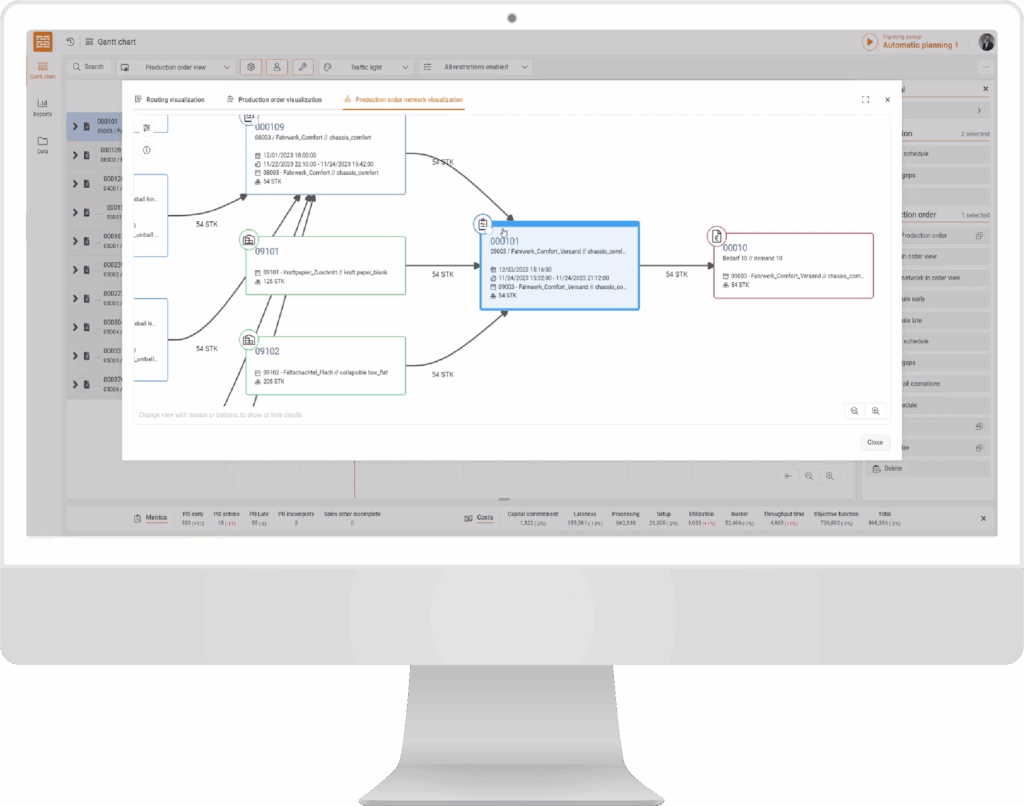
Effective production planning is essential for manufacturing efficiency, yet companies frequently encounter challenges such as limited transparency, rigid systems, scheduling complexities, communication issues, and hidden bottlenecks. These problems lead to inefficiencies, delays, and increased costs. To overcome these challenges, businesses should adopt advanced planning tools, flexible scheduling solutions, improved interdepartmental communication, data-driven analytics, and systematic knowledge management, ensuring better adaptability and competitiveness in production processes.
The top five challenges in production planning are:
Limited transparency across the value-added process
Rigid and outdated planning systems (like Excel)
Difficulty managing daily order scheduling
High communication effort between departments
Lack of visibility into production bottlenecks
Read further in the article Challenges in Production Planning.
集成与相关系统
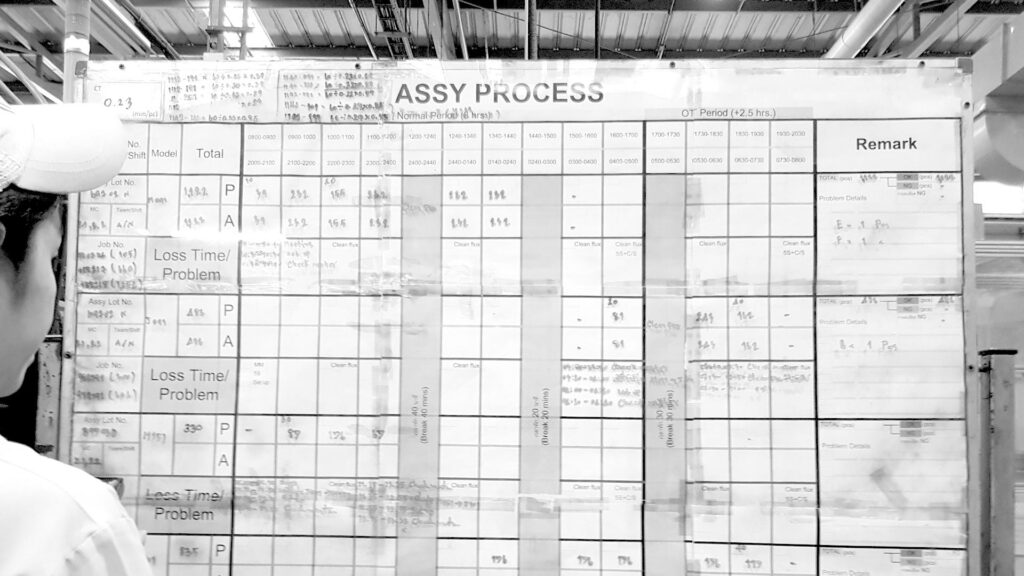
Fully integrated with leading ERP systems such as SAP, Microsoft, Oracle, Infor, and Comarch, our solution ensures smooth data flow and synchronisation across the entire production process. This seamless integration supports efficient planning, execution, and monitoring between ERP, APS, and MES systems.

企业资源规划
- Master and transaction data
- Personnel
- Work centers
- Production resources and tools
- Demands


APS
- Planning and optimization
- Gantt chart
- Order sequencing
- Consideration of constraints
- Analysis

MES
- Confirmations, machine and order state from
MES to Accevo APS - Shopfloor
符合监管要求与标准
ISA-95
ISA-95: Integration Standard between Enterprise and Control Systems
ISA-95 is a widely recognised international standard specifically designed to integrate business (enterprise) and manufacturing (control) systems. It provides a structured approach for data exchange between different operational levels, such as management and factory floor operations.
Improves Visibility and Transparency:
By standardising information flows, ISA-95 helps organisations gain clear visibility across the entire manufacturing process. This standard is crucial for identifying bottlenecks, reducing delays, and improving overall operational efficiency.Supports System Interoperability:
Companies employing ISA-95 experience smoother integration of Manufacturing Execution Systems (MES), Enterprise Resource Planning (ERP), and control systems. This interoperability is essential for dynamic production scheduling and real-time decision-making.Enhances Communication:
By standardising terminology and data formats, ISA-95 significantly reduces miscommunications and errors across departments, contributing to more efficient production planning.
Example: A pharmaceutical manufacturer using ISA-95 standards successfully integrates batch production data directly into its ERP system. This integration allows immediate adjustments based on demand forecasts, regulatory requirements, or production anomalies.
ISO 9001
ISO 9001 is an internationally accepted quality management standard focusing on consistent quality delivery, customer satisfaction, and continual process improvement.
Promotes Quality Assurance:
ISO 9001 provides a structured framework to ensure all production processes meet defined quality standards. It directly impacts planning by embedding quality checks into operational routines.Facilitates Risk Management:
By integrating preventive measures and regular audits, ISO 9001 helps identify potential issues in production processes before they escalate, aiding proactive planning and risk reduction.Encourages Continuous Improvement:
Implementing ISO 9001 promotes systematic tracking of performance metrics, enabling continuous improvements in production processes, resource management, and scheduling efficiencies.
Example: An automotive parts manufacturer certified with ISO 9001 systematically reviews production plans and quality metrics. This continuous monitoring ensures prompt action on discrepancies, reduces wastage, and improves production reliability.
系统介绍
联系我们的专家

为什么要得到一个演示?
- A 60-minute online meeting with a dedicated specialist presenting a top system from an industry similar to yours
- Live modeling of your production process
- A budget quotation after the meeting