







Software für die diskrete Fertigung
Accevo unterstützt diskrete Hersteller, die individuelle Produkte und Baugruppen mit Varianten, Seriennummern und mehrstufigen Arbeitsplänen herstellen.


























Was diskrete Hersteller in der Regel benötigen
This type of production often combines manual work, semi-automated stations, and automated cells. Common operational requirements include:
Visibility of WIP and order progress across multiple workstations
Serialisation and genealogy (what happened, where, when, by whom, with which materials/tools)
Quality gates, inspections, and controlled rework loops
Consistent operator execution (work instructions, step checks, confirmations)
Real-time machine and line performance (availability, speed losses, micro-stops, scrap)
Faster changeovers and better sequencing without losing traceability
Integration with ERP/PLM/WMS so master data and production results are consistent
Welche Lösungen bietet Accevo an?

Produktionsausführung in Echtzeit (MES/MOM)
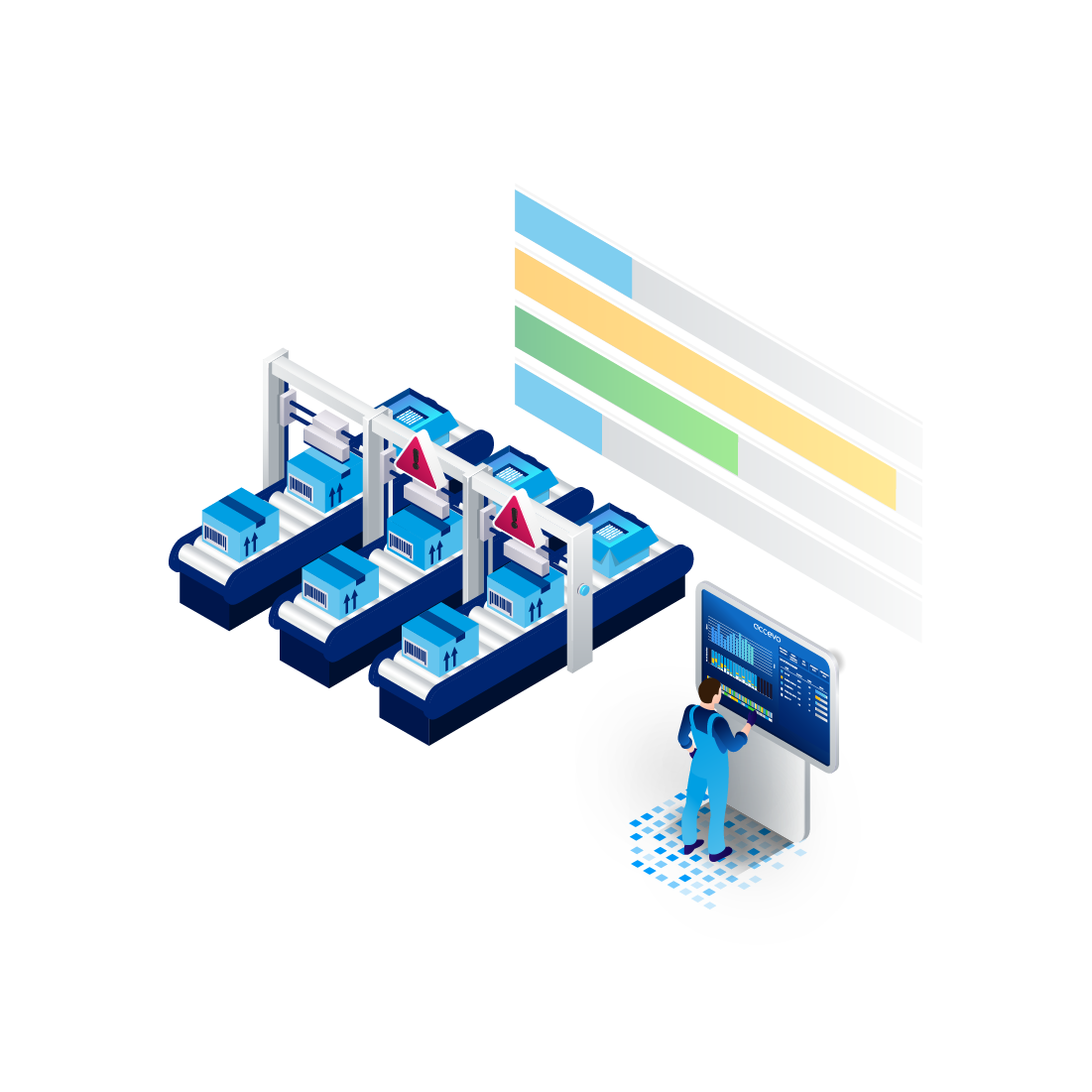
Track each operation against the production order and routing, with live status, confirmations, and exception handling. Capture production events automatically from machines where available, and manually where needed—without breaking the audit trail.
Rückverfolgbarkeit für serialisierte Produkte
Build an end-to-end product history that links:
- serial/lot identifiers
- operator and workstation
- machine parameters and key signals (where connected)
- used components/materials
- quality results and rework decisions
This supports investigations, supplier/customer claims, and regulatory or customer audits.
Bedienfelder, Barcode/RFID und geführte Arbeitsabläufe
Standardise work at the station level. Guide operators through steps, enforce required checks, and reduce missed actions (for example: scan-to-confirm, step completion, deviation handling, electronic sign-off).
Qualitätskontrollen und SPC
Run in-process and end-of-line quality controls with clear escalation rules. Detect trends early, react to out-of-limit measurements, and connect defects to orders, stations, and materials to reduce repeat issues.
Leistungsüberwachung (OEE und Mikrostopps)
Use APIs and standard integration patterns to exchange production data with ERP/PLM/WMS/SCADA, and provide consistent datasets for reporting, analytics, and AI use cases.
Produktionsplanung und Neuplanung (APS)
Sequence orders to reduce changeovers and stabilise flow. Use live shop-floor feedback to re-plan when priorities, constraints, or disruptions change.
Ausführung der Instandhaltung (CMMS)
Plan preventive maintenance, manage work orders, and connect downtime reasons with maintenance activities so you can prioritise actions that reduce recurring losses.
Datengrundlage und Integration
Use APIs and standard integration patterns to exchange production data with ERP/PLM/WMS/SCADA, and provide consistent datasets for reporting, analytics, and AI use cases.
Arbeitsanweisungen und digitale SOPs (Bedienerführung)
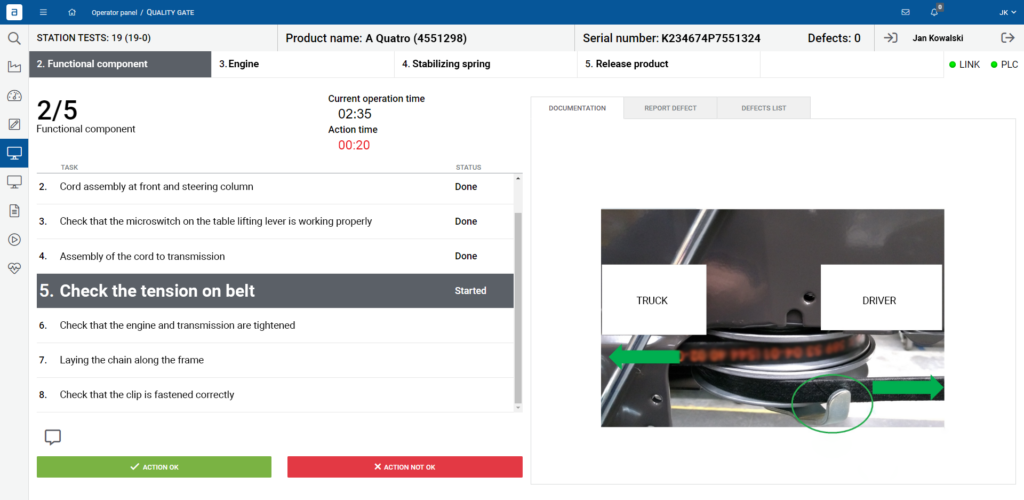
Accevo’s work instruction module delivers step-by-step guidance at the workstation, so operators follow the correct sequence for each product variant and operation.
Instructions can include checklists, images or documents, required scans (barcode/RFID), confirmations, and mandatory data capture (for example: torque values, measurements, test results). Each execution is recorded against the order, serial/lot, station, and operator, so you get a complete audit trail and consistent quality gates—especially useful on manual and semi-automated processes where variation and missed steps are common. This approach also supports faster onboarding by providing just-in-time, role-specific knowledge on the shop floor.
Beispiel für die Umsetzung der Rückverfolgbarkeit in der Automobilindustrie
In one discrete automotive project (LPG tank manufacturing), the solution combined machine connectivity, PLC and robot integrations, operator panels with barcode scanning, quality gates, automated testing stations, and real-time OEE reporting, resulted in:
reduction in dispatching tanks with errors
of machine availability per shift
quicker IATF audits
increase in quarterly production volume
Typischer Rollout für diskrete Anlagen
01
Verbinden und messen
machine connectivity + real-time performance monitoring
02
Ausführung kontrollieren:
station reporting, routing enforcement, operator panels
03
Nachweis der Rückverfolgbarkeit
serialisation/genealogy, material/tool validation, audit trails
04
Qualität stabilisieren
inspections, SPC, defect and rework loops
05
Fluss optimieren
APS sequencing and disruption-based re-planning
06
Verluste einschränken
maintenance workflows tied to downtime and failure modes