







Cloud Manufacturing
Un unico luogo sicuro per tutti i dati di produzione
Che cos'è il Cloud Manufacturing?
Cloud manufacturing is the application of cloud computing in manufacturing. It enables manufacturers to connect, share, and manage data and resources using the Internet. The concept of cloud manufacturing was proposed as a way to apply cloud computing to the global manufacturing industry. It can improve manufacturing efficiency and flexibility, and reduce costs.
Cloud MES is driving new opportunities:
- Horizontal integration of suppliers across the value chain
- Cloud-based MES solutions can help to improve horizontal integration across the supply chain. This is because cloud-based solutions can provide visibility into the manufacturing process from end to end. This visibility can help to identify bottlenecks and optimize the manufacturing process.
- Tracking carbon emissions
- Cloud-based MES solutions can help factories track their carbon emissions. By tracking production data, such as energy use, in the cloud, factories can identify opportunities to reduce their emissions. Additionally, cloud-based MES solutions can help factories track their progress towards emissions reduction goals.
- Seamless mergers and acquisitions
- Cloud-based MES solutions can help factories seamlessly merge with or acquire other factories. By tracking production data in the cloud, factories can easily share data between factories. Additionally, cloud-based MES solutions can help factories keep track of production schedules and recipes, making it easy to transition to a new factory.
- Dynamic production scheduling
- Cloud-based MES solutions can help factories dynamically schedule production. By tracking production data in the cloud, factories can quickly identify changes in demand and adjust production accordingly. Additionally, cloud-based MES solutions can help factories automatically generate production schedules based on customer orders.
- Development of new services
- Cloud-based MES solutions can help factories develop new services. By tracking production data in the cloud, factories can quickly identify opportunities to develop new requirements for services which can improve their production. Additionally, cloud-based MES solutions can help factories track customer demand for new services.
Architettura della soluzione cloud: che aspetto ha?
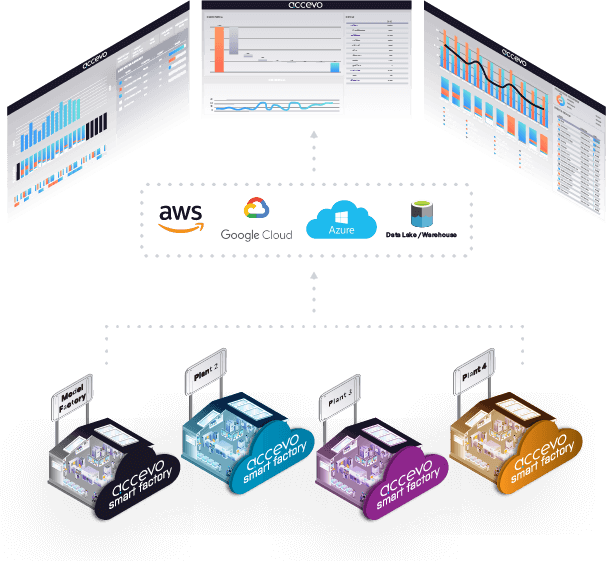
A cloud-based MES solution typically includes a web-based user interface, a database, and application servers. The web-based user interface provides users with access to the MES solution from any location with an internet connection. The database stores data about the manufacturing process, such as recipes, production schedules, and product data. The application servers host the MES software and provide the processing power for the solution.
MES basato su cloud, ibrido o on-premise: quali sono le differenze?
Cloud-based MES or on-premise, what are the differences?
There are many differences between on-premise and cloud-based MES solutions. One of the biggest differences is that on-premise solutions are typically more expensive to implement and maintain than cloud-based solutions. On-premise solutions also require more IT infrastructure and support than cloud-based solutions. Cloud-based solutions are typically easier to implement and require less IT support. Another difference is that on-premise solutions are usually more customizable than cloud-based solutions. On-premise solutions can also be more difficult to upgrade than cloud-based solutions.
Which is better for your business?
The best answer for this question depends on the specific needs of your business. If you have a large budget and the need for a lot of customization, an on-premise MES solution may be a better option. If you have limited resources and the need for a less complex solution, a cloud-based MES solution may be a better option.
What about hybrid MES architecture?
A cloud hybrid model architecture is a combination of on-premises, private cloud, and public cloud services. This type of architecture allows organizations to use a mix of different cloud deployment models to optimize their operations and meet their specific business needs. With a cloud hybrid model, organizations can keep some data and applications on-premises for security and compliance reasons, while also leveraging the benefits of the public cloud, such as scalability and flexibility. This approach allows organizations to take advantage of the best of both worlds and create a more flexible and scalable IT environment.
MES functionality is increasingly moving to the cloud. ~46% of manufacturers have or are considering cloud MESAccording to a 2018 AWS / IDC survey of German and American MES users
Cloud in un ambiente di produzione
Quali sono i vantaggi e gli svantaggi?
Cloud-based MES solutions have many benefits, including lower upfront costs, lower IT support costs, and easier implementation. However, cloud-based solutions can be less customizable than on-premise solutions and may be more difficult to upgrade. Find out what solution suits your business best by contacting us today.
Benefits
-
Scalabilità
Possibilità di collegare un numero illimitato di linee di produzione, attrezzature e fabbriche, nuove risorse su richiesta, alleviando la crescente domanda di risorse -
Accessibilità
Facile accesso ai dati operativi in tempo reale, in qualsiasi momento e da qualsiasi luogo. Gli operatori possono accedere alle applicazioni da qualsiasi impianto di produzione, la gestione della fabbrica da qualsiasi luogo. -
Agilità e flessibilità
Allocazione agile e adattabile delle risorse quando si tratta di aumentare o diminuire le dimensioni delle operazioni. Questo è importante quando la produzione aumenta e il MES deve essere scalato rapidamente e facilmente. -
Migliore utilizzo delle risorse IT
Facile da implementare, non richiede infrastrutture hardware o di rete né il coinvolgimento di team IT. Una volta implementato, MES non richiede costosi aggiornamenti, manutenzione dei server o frequenti controlli. -
Servizi cloud aggiuntivi
Esistono diversi servizi Cloud che possono essere utilizzati come estensione del sistema MES: BI, AI e Reporting. L'aggiunta di nuovi servizi è solo uno sforzo di configurazione -
Sicurezza migliorata
Sicurezza standard di alto livello, con manutenzione del software e aggiornamento della sicurezza da parte del fornitore del Cloud. Tuttavia, con un MES on-premise, la sicurezza è costosa e richiede aggiornamenti regolari. -
Alta disponibilità
Possibilità di aumentare la disponibilità e la ridondanza senza costi di investimento significativi
Drawbacks
-
Alta latenza
Le aziende che prendono in considerazione il cloud MES devono verificare la posizione del server cloud nel paese o nella regione in cui si trova la fabbrica. connessione di rete tra il server MES e la fabbrica. Infine, la quantità di dati trasferiti tra il MES. In caso di perdita di connessione, è necessario installare un buffer interno per memorizzare i dati di produzione. -
Flessibilità limitata
Sebbene il cloud MES offra molti vantaggi, uno degli svantaggi è che può essere meno flessibile del MES on-premise. Ciò è dovuto al fatto che il MES in cloud viene generalmente fornito come soluzione software-as-a-service (SaaS), il che significa che le opzioni di personalizzazione sono limitate. Se avete bisogno di una soluzione MES altamente personalizzabile, una soluzione on-premise può essere un'opzione migliore. -
Proprietà dei dati controversa
Uno dei potenziali svantaggi delle soluzioni MES basate sul cloud è che i dati generati dalla soluzione MES possono essere di proprietà del fornitore MES. Questo può essere un problema se si vuole cambiare fornitore MES o se si vogliono conservare i dati per scopi interni. Assicurati di verificare con il fornitore MES chi è il proprietario dei dati prima di scegliere una soluzione. -
Possibile costo più elevato
Le soluzioni MES basate sul cloud possono diventare rapidamente più costose delle soluzioni on-premise. Questo perché le soluzioni basate sul cloud hanno in genere un prezzo in base all'utilizzo dei dati e alla potenza di elaborazione, che conta nell'infrastruttura virtuale e nell'assistenza. Se state prendendo in considerazione una soluzione MES basata sul cloud, assicurati di ottenere un preventivo personalizzato per determinare il costo reale della soluzione in diverse circostanze.
Cloud means a new approach to development – DevOps
Cloud-based MES solutions require a new approach to development, called DevOps. DevOps is a set of practices that combines software development and IT operations to deliver applications and services faster. DevOps is essential for cloud-based MES solutions because of the need to rapidly develop and deploy new features and updates.
Cloud means new methodology – DevOps approach:
- Adopt cloud-native tools and practices
- Managed services over self-maintenance
- Re-architect toward adoption of new concepts
- Achieve self-healing capabilities
- SDLC (Software Development Life Cycle) for managing different environments and automating migration between environment
The goal for using the new methodology is:
- Automation of deployment and quality assurance (Automated upgrades and installation process)
- CI/CD – continuous integration and delivery
- Automated provisioning of infrastructure and its scalability (IaaS)
- Usage of cloud-native tools for performance monitoring, logging, security, code scanning, audits, etc.
- Automated testing (unit and end-2-end) as part of SDLC
Sicurezza dei dati di produzione nel cloud: a cosa prestare attenzione?
One of the biggest concerns with cloud-based MES solutions is the security of production data. Production data is often sensitive and confidential, so it is important to choose a MES solution that has strong security features. Look for a solution that offers user authentication, data encryption, and access control.

Modern approach to SLA – split of responsibility:
Responsibilities:
- The cloud service provider takes responsibility for everything that is happening in the Cloud.
- The customer is responsible for providing internet service and performing maintenance tasks on connectivity infrastructure and Edge devices.
Disaster Recovery:
- All data is periodically backup up in the Cloud using Recovery Services.
- Data redundancy should be set on Zone level which prevents loss of any data at twelve nines, but backups are still performed to have a way to recover from Accevo data corruption or deletion caused by a bug or other destructive behaviors of the systems and its users.
- The server itself should be automatically recreated on another Node when the cluster self-heals. In an extreme case of cluster failure, a new cluster from CI/CD should be created and the service will be deployed.
Soluzioni cloud in fabbrica: quanto costa?
The cost of a cloud-based MES solution depends on many factors, such as the number of users, the number of production lines, and the level of customization. Contact us today to get a customized quote for your business.

Thanks to our solution called “push interface,” we are able to transfer data from the MES Accevo system to a ready-made data warehouse or create one for the client themselves. This enables analysts in a manufacturing company to synthesize and retrieve data from multiple sources into PowerBI and create custom charts for analyzing the factory’s situation. For example, an overview of the factory, start analysis, MTBF analysis, quality analysis, or waste analysis. Accevo has the capability to integrate with multiple database solution providers such as Azure Synapse or Snowflake for data processing and analysis in the cloud. Snowflake can be configured on any cloud infrastructure.
The process we utilize is ETL: Push (Extract) -> Store Raw Data (Transform) -> Apply to Data Warehouse (Load).
Utilizzate i dati da più fonti con PowerBi
Ottieni il Cloud MES per la tua fabbrica con Accevo
Accevo is a leading provider of cloud-based MES solutions. Our solutions are designed to help manufacturers optimize their production processes and improve their bottom line. Contact us today to learn more about our solutions and get a free demo.
Iscriviti alla nostra newsletter
Prodotti correlati
Sistema di gestione dell'energia (EMS)
Sistema di gestione energetica (EMS) Monitora i consumi in tempo reale e riduci i costi Prenota una demo Che cos’è Accevo EMS? Il sistema di gestione energetica (EMS) di Accevo è

Sistema di gestione del magazzino (Shopfloor WMS)
Sistema di gestione del magazzino di produzione (spWMS) Monitoraggio delle scorte nel magazzino di produzione Prenota una demo Sistema WMS per il magazzino di produzione: gestisci il tuo magazzino in modo efficiente! Manutenzione
Sistema MES - Sistema di esecuzione della produzione - Accevo
Sistema MES – Manufacturing Execution System: misurate e analizzate il vostro processo produttivo con il sistema MES e individuate le aree in cui è possibile ottenere maggiori miglioramenti. Prenotate una presentazione sul funzionamento del sistema.